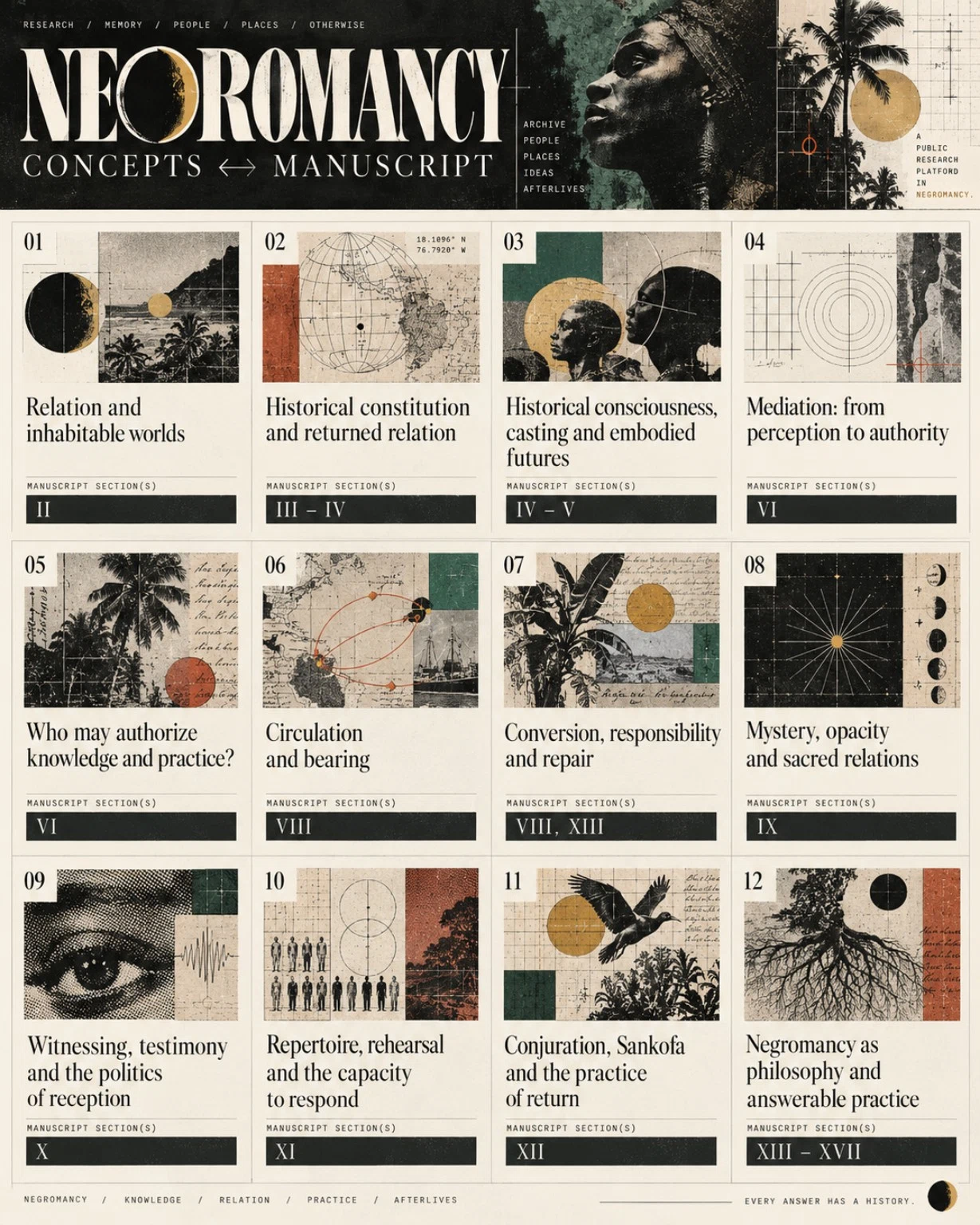
The preceding arguments suggest that Negromancy is developing toward a philosophical account of historically mediated existence and the cultivation of transformative capacity. Its starting point is relational rather than individualist. Its understanding of subjectivity is historical and embodied rather than self-originating. Its conception of history extends beyond completed events toward the ongoing constitution of present life and future possibility. Its account of knowledge investigates the mediations through which relations become perceptible, recognizable, and authoritative. Its understanding of power includes the organization of the conditions under which beings acquire or are denied capacities to recognize, act, and transform relations. Its ethics attends to the distribution of bearing and to the distinction between preserving coherence and repairing its conditions. Its practice depends upon encounter, historical inquiry, performance, testimony, rehearsal, and answerable intervention. Its epistemic limits are protected by distinctions among observation, inference, testimony, sacred interpretation, ethical judgment, and unresolved possibility. And its refusal of total possession is expressed through opacity and Mystery. These commitments do not yet establish an entirely coherent philosophical system. Several conceptual relationships require further development.
Unresolved theoretical tensions
1. Relation and ontology Does Negromancy make a claim about the fundamental constitution of reality, or primarily about the historical relations through which particular worlds become encounterable? The two claims must be distinguished. A theory of historically mediated perception does not, by itself, establish a general relational ontology.
2. Historical constitution and agency If bodily capacities and interpretive repertoires are historically constituted, what explains the emergence of responses that exceed established forms? Rehearsal provides one practical model, but it does not fully explain how genuinely new capacities or possibilities emerge.
3. Mediation and material causality A mediation can alter recognition without altering the underlying material process. In other cases, categorization or institutional recognition may causally change the relations being described. Negromancy needs a disciplined account of these differences.
4. Opacity and knowledge If all encounters remain incomplete, what distinguishes a productive recognition of explanatory limits from a failure to investigate sufficiently? Opacity must not become a means of protecting weak arguments from correction.
5. Spirit and causal explanation Negromancy must preserve the integrity of spiritual experience and historically situated sacred practices while maintaining appropriate standards for claims about causal mechanisms. No single vocabulary should automatically settle the status of every encounter.
6. Bearing and repair A transformation may redistribute burdens while producing new ones. How should competing obligations, unavoidable costs, and conflicting interests be evaluated? The refusal of sacrificial bearing establishes a powerful ethical orientation, but not a complete account of political decision-making.
7. Witness and authority Who may legitimately claim to witness, represent, or interpret a relation? What distinguishes developed capacities of discernment from claims of privileged access that reproduce domination? This becomes particularly important where sacred, scientific, legal, and political forms of authority intersect.
8. Historical specificity and general application Negromancy originates in Black-Caribbean historical experience. Its conceptual reach may extend beyond that experience, but doing so must not erase the histories that made the method necessary or imply that every society reproduces the same mechanisms.
9. Performance and explanation Performance can make relations available for investigation and may transform participants. It is not automatically an explanation of what produces them. Negromancy must continue distinguishing the epistemic and practical contributions of performance from the causal claims made about social and historical processes.
10. Theory and its own conditions of production Negromancy itself has emerged through historically situated bodies, conversations, scholarly traditions, artistic practices, technologies, and interpretive procedures. If the framework takes mediation seriously, it must remain capable of examining the conditions through which its own concepts become intelligible and authoritative. Its methods must therefore be available for revision under the same standards of critical attention that it brings to other systems.
 Morrow